Australian History
To Constitute a Nation: A cultural history of Australia’s constitution by Helen Irving
Remarkably to some, this cultural history of the drafting of the Australian constitution is an exciting and triumphant book. Helen Irving manages to fill in adroitly the blank pages of our constitution as a cultural artefact and to celebrate the complicated processes whereby Australia became a nation on the first day of the new century.
To actually write the framework for a nation by agreement indeed represents a concentrated act of the imagination. Moreover, it demonstrated, in the closing years of the nineteenth century, a profound optimism in this country’s future. As Irving rightly argues, the nation of Australia itself was the product not of external pressure or crisis, nor due to any religious or ethnic imperatives, but was created in a time of peace. This achievement, and the codification of our national powers and institutions, despite their obvious limitations, rightly deserves celebration.
... (read more)Never Trust a Government Man by Tony Austin & The Way We Civilise by Rosalind Kidd
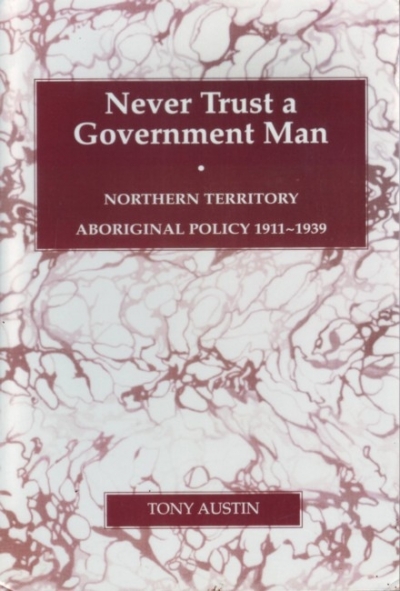
Tony Austin and Rosalind Kidd are nonindigenous Australian scholars whose special contribution to the history of black-white relations in this country is to have researched the policy detail, culture, and interpersonal intricacies of the white bureaucracy that dealt with Aboriginal affairs in a large part of northern Australia. As each of them documents over and over again, the white males who exercised government power over indigenous Australians went to great lengths to avoid consulting those they governed or to include them in the decision-making process. The present books therefore do not claim to represent an Aboriginal point of view; their object of study is white policy and malpractice. Never Trust a Government Man and The Way We Civilise are each the outcome of archival research using government departmental documents, beginning at roughly the same period – from the time early this century – that a newly created Australian Federal Government first began to face its responsibilities towards indigenous people.
... (read more)The Virtual Republic: Australia’s culture wars of the 1990s by McKenzie Wark
‘Ken Wark,’ says Linda Jaivin on this jacket, ‘makes postmodernism sexy.’ First cabbages, now postmodernism! Where can she take us from here? The trouble is I don’t believe her. Now that’s too easy a write-off. I’m not instinctually warm to The Virtual Republic, and I think Linda Jaivin’s line is a more than normally meretricious blurb, but Wark’s enterprise is essentially a request for conversation and why not accede to that. Still I want to protest even as I converse. The book is an olive branch masquerading as a polemic. Or, like Lindsay’s parrot who was a swagman, is it the other way round?
... (read more)In a course on Australian popular culture, I routinely ask students a pair of questions: is Australian culture increasingly Americanised; is Australian culture increasingly distinctive and original? They routinely answer yes to both. Australian National Cinema suggests why there might be more than poor logic behind their response. Its contradictoriness tells us something fundamental about how Australian cinema exists in the cinema world and the social world.
... (read more)The Silence Calling: Australians in Antarctica 1947–97 by Tim Bowden
As Tim Bowden would well remember, the ties of Hobart to the Antarctic have been visible long before the transfer of the Antarctic Division from Melbourne to Kingston, south of Hobart, in 1982, and the establishment of the Institute of Antarctic and Oceanic Studies at the University of Tasmania six years later. From the 1950s, the chartered Scandinavian vessels that carried members of the Australian National Antarctic Research Expeditions, Nella, Kista, Magga and other Dans, set out from Hobart early each summer. To look south down the Derwent was to know that one was truly at the end of the inhabited world. Yet if no permanent settlement has ever been created in Antarctica, thousands of Australians have worked and wintered there. The Silence Calling is Tim Bowden’s exemplary record of their achievements in this, the golden jubilee year of the ANARE.
... (read more)‘The historical aspects of The Rocks should not be oversold’, declared a recent Sydney Cove Authority strategic plan, ‘it should be used as a background’. In this sanitised heritage precinct, tourists might thrill to the hint of a raffish past, but should be shielded from more intimate and disturbing glimpses. This is always easy in the absence of systematic research.
... (read more)Depraved and Disorderly: Female sexuality and gender in colonial Australia by Joy Damousi
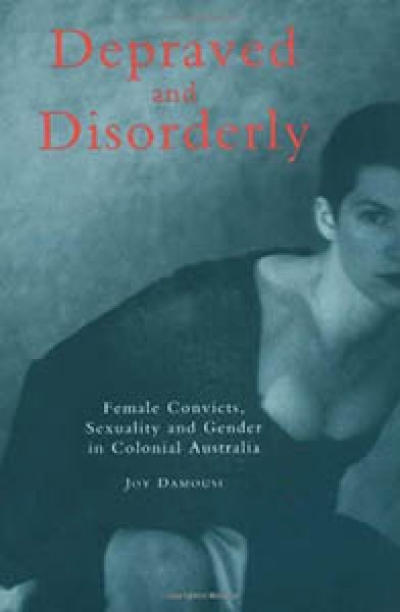
Much of the evidence and source material used in Depraved and Disorderly, particularly in Part One, will be familiar to the scholar of female convict history. But Joy Damousi provides some additional material which is both original and evocative. For example, her discussion of lesbianism and tattooing as both challenging to contemporary concerns about sexuality and social order, and as another means by which these women could express their own identities, provides evidence of the diversity of characters among convict women, as well as broadening our understanding of colonial society. More importantly, however, Damousi adds a further theoretical dimension to the already complex and contradictory historiography which surrounds the female convict.
... (read more)Adam Shoemaker reviews 'In the Age of Mabo: History, Aborigines and Australia' edited by Bain Attwood
Some of Australia’s most cogent historical analyses grow out of particular social moments: the close of World War II, the accession (and dismissal) of the Whitlam government, the bicentennial celebrations and protests of 1988. The High Court’s Mabo decision of June 1992 is just such a moment and it is no surprise to find another book which focuses on the aftermath of that landmark decision. Interestingly, In the Age of Mabo is also just as strongly the product of a certain time and political space: the 1991–96 prime ministership of Paul Keating. It is this framework which gives this varied collection of essays its sense of historical occasion; it is also this political underpinning which renders at least one of the contributions nearly obsolete.
... (read more)Hunters and Collectors: The antiquarian imagination in Australia by Tom Griffiths
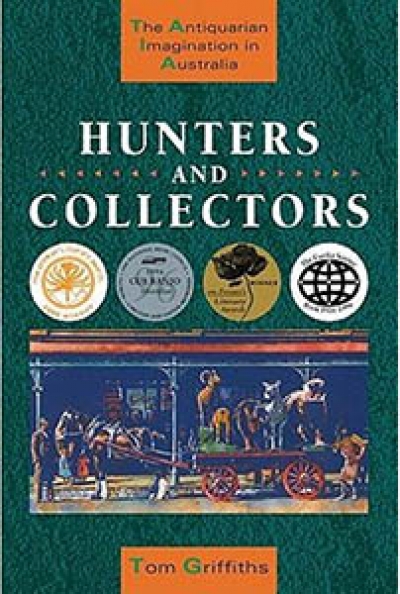
Six weeks after the First Fleet sailed for New South Wales Edward Gibbon completed The Decline and Fall of the Roman Empire. Probably the finest example of the Western tradition of history as chronological and sequential, Gibbon’s work provided the Europe of his time with a panoramic background against which the achievements of modern civilization could be measured.
... (read more)The Empire Fractures: Anglo-Australian Conflict in the 1940s by Christopher Waters
The central contention of this provocative, well-written, and extensively researched study is that Australia underwent a process of decolonisation during the 1940s, and that only by understanding this can we make sense of the subsequent relationships between Australia, Britain and the United States.
... (read more)